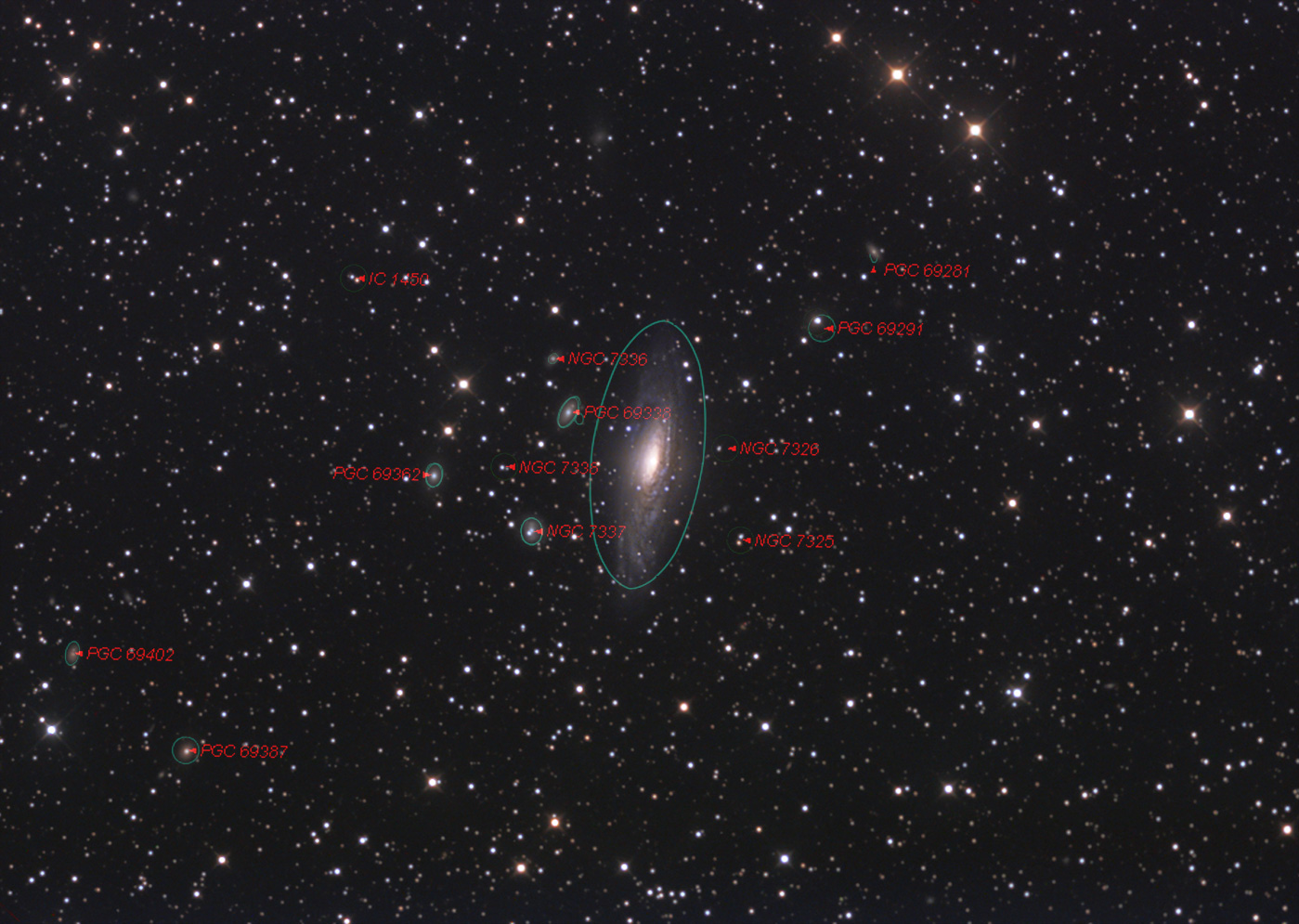
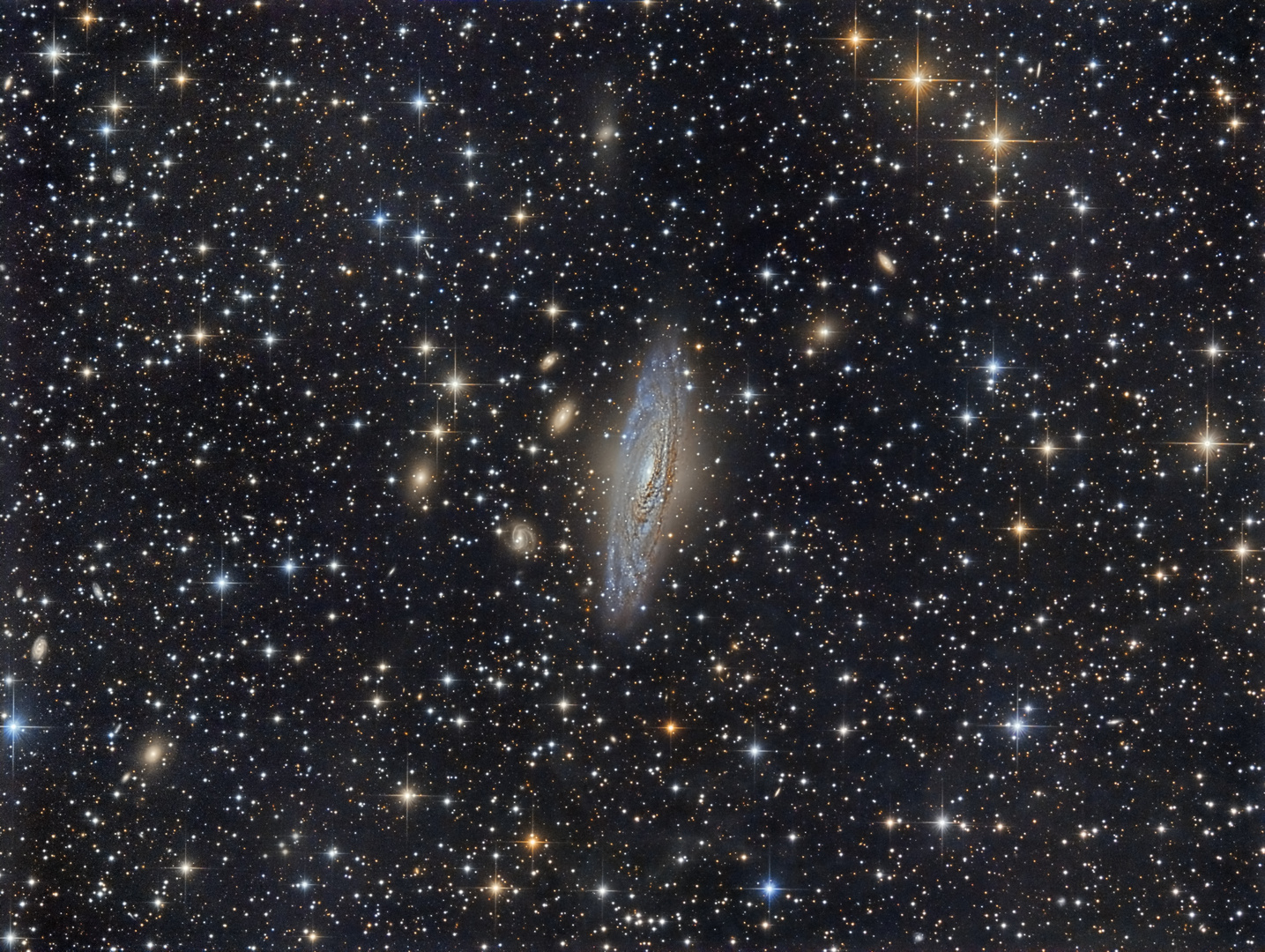
NGC 7331, also known as Caldwell 30, is an unbarred spiral galaxy about 40 million light-years (12 Mpc) away in the constellation Pegasus. It was discovered by William Herschel on 6 September 1784.
The galaxy appears similar in size and structure to the Milky Way, and is sometimes referred to as "the Milky Way's twin". However, discoveries in the 2000s regarding the structure of the Milky Way may call this similarity into doubt, particularly because the latter is now believed to be a barred spiral, compared to the unbarred status of NGC 7331. In spiral galaxies the central bulge typically co-rotates with the disk but the bulge in the galaxy NGC 7331 is rotating in the opposite direction to the rest of the disk. In both visible light and infrared photos of the NGC 7331, the core of the galaxy appears to be slightly off-center, with one side of the disk appearing to extend further away from the core than the opposite side.
Galaxy Groups
NGC 7331 is the brightest galaxy in the field of a visual grouping known as the NGC 7331 Group of galaxies. In fact, the other members of the group, NGC 7335, NGC 7336, NGC 7337 and NGC 7340, lie far in the background at distances of approximately 300–350 million light years.
All of the members of the NGC 7331 Group, along with NGC 7325, NGC 7326, NGC 7327, NGC 7333, NGC 7338, are listed together as Holm 795 in Erik Holmberg's A Study of Double and Multiple Galaxies Together with Inquiries into some General Metagalactic Problems, published in 1937.
Supernovae
Three supernovae have been observed in NGC 7331:
- SN 1959D (type II-L, mag. 13.4) was discovered by Milton Humason and H. S. Gates in a survey at Palomar Observatory on 28 June 1959.
- SN 2013bu (type II, mag. 16.6) was discovered by Kōichi Itagaki on 21 April 2013.
- SN 2014C was discovered by the Lick Observatory Supernova Search (LOSS) on 5 January 2014. The star underwent an unusual "metamorphosis" from a hydrogen-poor Type Ib to a hydrogen-rich Type IIn over the course of a year.
- In addition to the confirmed supernovae, a 1903 photographic plate from Yerkes Observatory shows a magnitude 16.6 candidate transient that may have also been a supernova.
See also
- M94 – another galaxy with a prominent starburst ring
- NGC 1512 – another galaxy with a prominent starburst ring
- Flocculent spiral galaxy
- List of NGC objects (7001–7840)
References
External links
- Media related to NGC 7331 at Wikimedia Commons
- Calar Alto Observatory – NGC 7331
- APOD (2004-07-01) – "A Galaxy So Inclined"
- SST – "Morphology of Our Galaxy's 'Twin'"
- NGC 7331 at the astro-photography site of Mr. T. Yoshida
- NGC7331 at W. Kloehr Astrophotography
- NGC 7331 on WikiSky: DSS2, SDSS, GALEX, IRAS, Hydrogen α, X-Ray, Astrophoto, Sky Map, Articles and images
- SEDS – NGC 7331