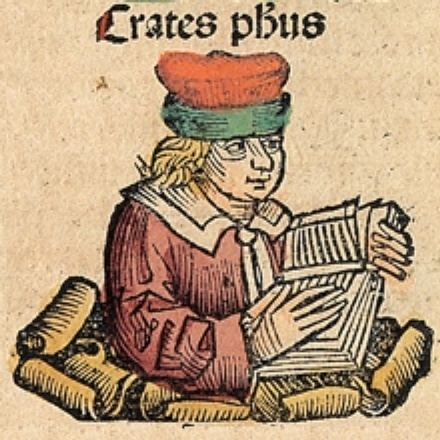
Crates of Athens (Greek: Κράτης ὁ Ἀθηναῖος; died 268–264 BC) was a Platonist philosopher and the last scholarch of the Old Academy.
Biography
Crates was the son of Antigenes of the Thriasian deme, the pupil and eromenos of Polemo, and his successor as scholarch of the Platonic Academy, in 270–69 BC. The intimate friendship of Crates and Polemo was celebrated in antiquity, and Diogenes Laërtius has preserved an epigram of the poet Antagoras, according to which the two friends were united after death in one tomb. The epigram, according to him, reads:
The most distinguished of the pupils of Crates were the philosopher Arcesilaus, who succeeded him as scholarch, Theodorus the Atheist, and Bion of Borysthenes. The writings of Crates are lost. Diogenes Laërtius says that they were on philosophical subjects, on comedy, and also orations; but the latter were probably written by Crates of Tralles.
Notes
References
- Dorandi, Tiziano (1999). "Chapter 2: Chronology". In Algra, Keimpe; et al. (eds.). The Cambridge History of Hellenistic Philosophy. Cambridge: Cambridge University Press. ISBN 9780521250283.
- Laërtius, Diogenes (1925). "The Academics: Crates" . Lives of the Eminent Philosophers. Vol. 1:4. Translated by Hicks, Robert Drew (Two volume ed.). Loeb Classical Library.
Attribution:
- This article incorporates text from a publication now in the public domain: Smith, William, ed. (1870). "Crates". Dictionary of Greek and Roman Biography and Mythology. Vol. 1. p. 883.
External links
- Life of Crates